Posts

Showing posts with the label flour

Specialty Flours for Gluten-free Baking

Image
Last month I wrote a post about basic gluten-free flours : their properties, their uses, their virtues, and their downsides. Here is the promised extension to that original post, which hopes to shed some light on some other more specialized GF grains. Amaranth flour (also known as Inca wheat or quihuicha): This flour behaves quite a bit like sorghum flour, and has a lot of flavor. It is a grain high in protein and very nutritious. A dough made with amaranth is very delicate, wet, and tricky to handle. I only use a small portion of this flour in my all-purpose mixes for the flavor it adds. Buckwheat flour : a close relation to rhubarb, this grain is in no way related to the wheat family. It is a very dark flour with a strong, distinctive and pleasant nutty flavor. The flour has a very fine grit, and can be used in making whole-grain products. It does not behave well on its own, producing very dry and brittle product unless it is mixed with other flours. I usually recommend s...

Tips for Finding the Right Bread

Image
I wanted to write a quick note on how I have found a few store-bought breads that I like. I have a method that I employ in selecting a good loaf, and for avoiding the hard, virtually inedible bread that some well-meaning companies try to pass off as nutritious. Some of these tips can even be used for gluten-free and wheat-based breads alike! Here is a step-by step procedure on how to select the best loaf for you. 1) Pick up the bread. Note its weight. If it seems unusually heavy, it is probably a very dense bread. This can sometimes be a bad sign for gluten-free products, as it indicates that the dough hasn't risen much, a problem typical with GF products. In itself, heaviness is not always a deal-breaker. 2) Squeeze the loaf. It should be a little resilient. If the loaf is both very heavy and un-squeezable, you may have a coarse, hard bread on your hands. 3) Look at the ingredients. If there is only one type of grain in the bread, then it is probably fairly tasteless, an...

Mixed-up Flours

Image
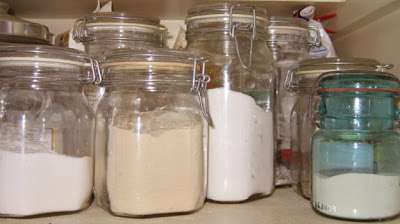
The first time I tried to make scones with a GF flour mix the dough smelled like salty beans. I looked at the ingredients on the store-bought package only to find - sure enough - garbanzo bean flour. After trying a few other pre-made mixes with similarly disastrous results, I decided I could do better on my own. Over the last year or two I've been experimenting with making my own gluten-free flour mixes. While I'm not quite ready to share this secret concoction with the world, I do want share what I've learned about the properties of some basic gluten-free flours. Brown rice flour : It gives your product lots of texture and flavor. However, it is not pliable enough to be used by itself in most recipes, and it produces a dense, heavy, whole-grain feel. White rice flour : This gives you a somewhat lighter and more pliable dough than brown rice flour, but without the benefit of the flavor of the whole grain. It is made from raw white rice. Glutinous rice flour (or stick...